


 |
 |
 |
 |
 |
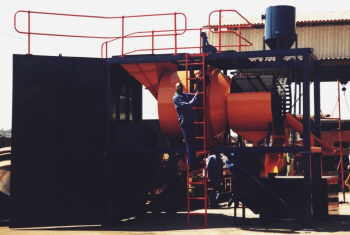

RG150 and RG60 Rubble Scrubbing Plants set to revolutionise local mining industry
A whole new concept of minimal energy input to enhance gravity recovery has arrived. Taking advantage of natural alluvial horizons and rubble beds, the concept of high efficiency autogenous scrubbing is applied to liberate and clean target minerals including gold, tantalite, chromite and others.
New Design
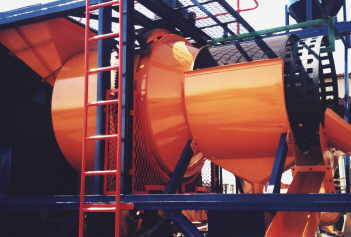
Developed by Peacocke, Simpson & Associates and marketed throughout the region by Small Mining Supplies, the new design scrubbers incorporate box-frame structures for lightness, strength and easy location on site. The drive system has been simplified and uprated to make for smooth, quiet operation that incorporates fail-safe features. Most scrubber designs are roller supported, making an absolutely level site essential, but the new RG design departs from this making it far easier to set up. In fact, formal foundations are not even necessary for the RG60, which can simply be placed on firm ground.
The RG60 has a nominal capacity of 4-6 tph and the larger RG150 10-15 tph.
High Efficiency
The RG series scrubbers incorporate a novel autogenous action to result in the retention of rock load to disintegrate even the most stubborn clays. The development trials were conducted on brick-field soils with over 90% clay, and even this was dealt with! Schist and decomposed rock also make ideal feed, and in this case a degree of breakage and grinding takes place. The drum is large in diameter by comparison with conventional scrubbers of like nameplate capacity, but this was found to be absolutely essential to deal with African materials. “We found to our detriment that conventional tube scrubbers from overseas did little more than agglomerate these tough clays”, said Peter Simpson. “We had to look at more efficient energy input into the material, and that means larger drum diameter. We opted for the belly type drum to give an overall compact aspect”.
Low Power Requirement
The light-weight construction coupled with the efficient action has resulted in extremely low power requirements of 5.5kW for the RG60 and 11kW for the RG150. This equates to about 1kWH/tonne processed as compared with about 14kWH/tonne for conventional milling! Even with the rest of the process module requirements, the overall power is minimal and well within the realms of power generation, a prime consideration for remote locations.
Complete Modules
Both scrubbers are coupled with high efficiency Knelson centrifugal concentrators or spirals depending upon the task, and all pumps, water tanks and cleanup devices are included to result in perfectly balanced comprehensive modules. This is extremely important as the overall efficacy of the solution is only as good as the weakest link. Although the simplicity of design and concept is sensitive to capital, there has been no compromise at the expense of efficiency. “In summary, there are no cheap processing solutions, the less costly ones are usually far more expensive”, said Kevin Woods, director of SMS.
The modules are sized and designed by professional process engineers and include everything necessary barring power and water. “The RG60 Gold Module can literally commence production the same day it arrives on site”, said process developer Barnabas Moyo.
No Mercury or Other Chemicals!
The RG modules operate on physical principals requiring nothing other than power and water. The Gold Module incorporates a Gemeni cleanup table to result in a directly smeltable product without mercury. A further advantage of the Gemeni is that yield is visible, so the performance can be assessed on a continuous basis.
 |
 |
 |
 |
 |